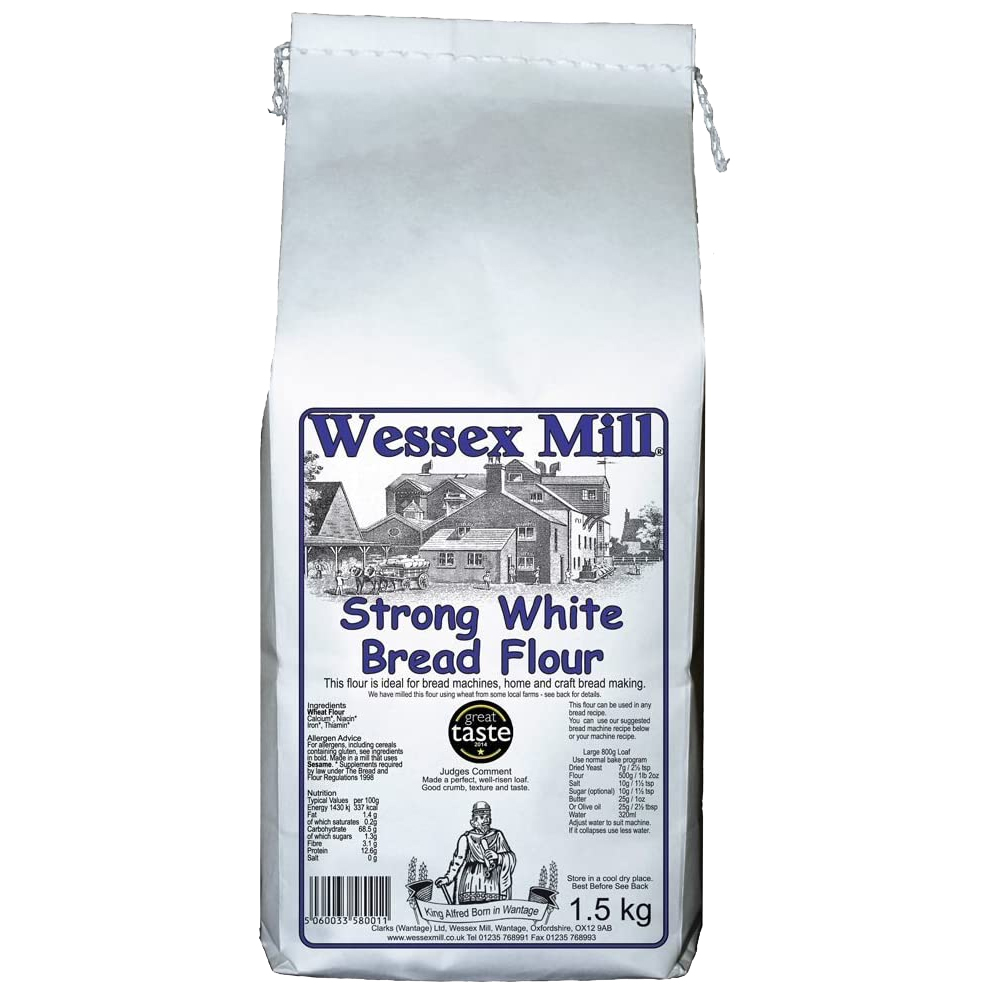
Strong White Bread Flour
1.50 kg
HKD$58.00
This flour can be used in any bread recipe. It is ideal for bread machine, home and craft bread making. It is milled by using wheat from some local farms.
Country of Origin
United Kingdom
Brand
Wessex Mill
Wheat flour, *Calcium, *Niacin, *Iron, *Thiamin (*Supplements required by law under The Bread and Flour Regulations 1998)
Weight
1.50 kg
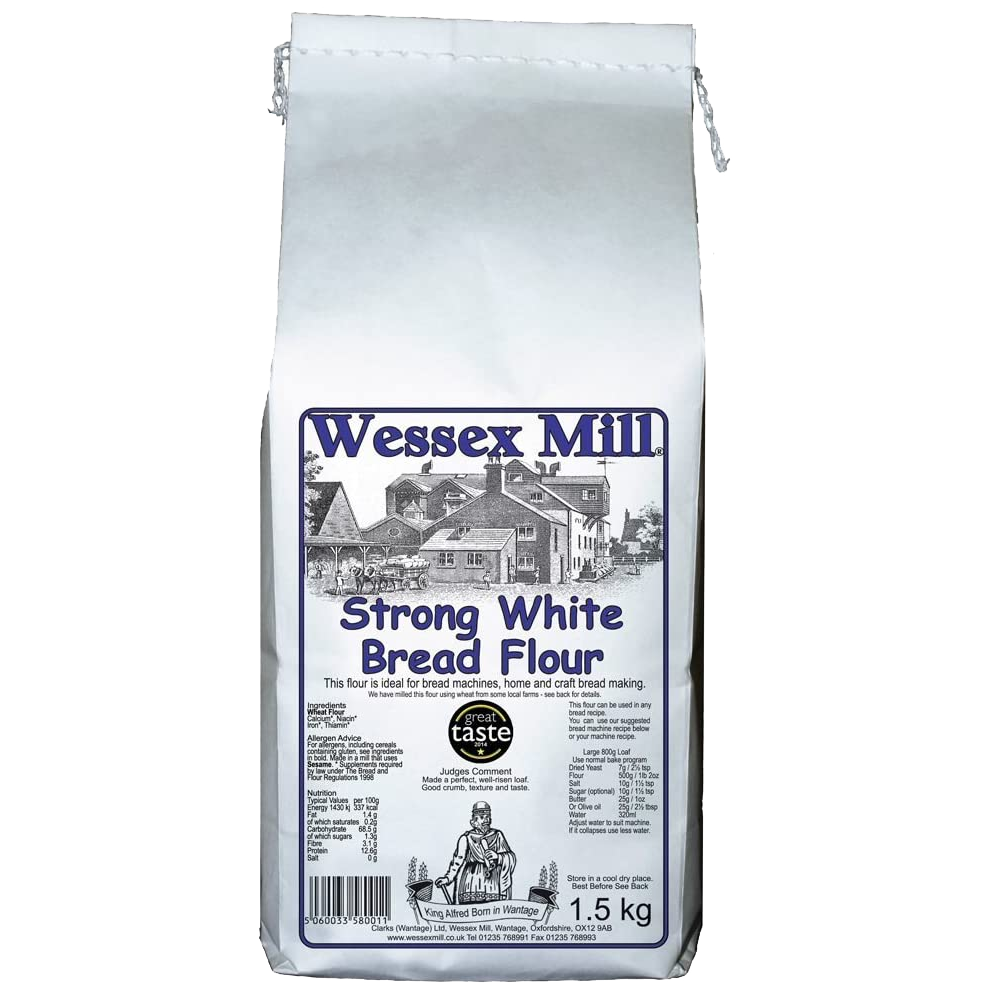
Strong White Bread Flour 1.5kg

Awarded 2 Stars in The Great Taste Awards.
Judges comment " Made a perfect, well-risen loaf. Good crumb, texture and taste."

All flour in the uk is unbleached ours is no exception.
We collect wheat from local farms and grind it slowly on our 1935 built rollermills. The name of the farms can be found on the back of the pack.

Ingredients
Wheat Flour, Calcium*, Niacin*, Iron*, Thiamin*,
*Supplements required by law under The Bread and Flour Regulations 1998
Allergen Advice
For allergens, including cereals containing gluten, see ingredients in bold. Made in a mill that uses Sesame.
Nutritional Values
of which saturates saturated
0.2 g
of which sugar
1.3 g
where our wheat comes from
Collecting wheat from a local farm
Examine Flour Quality
Flour Quality - Gluten

Wheat is unique in being the only grain that contains gluten. Gluten is elastic and can hold bubbles of air, when you make bread you are trapping bubbles of air.
>Washing gluten to find out the quality

To do this we need a flour that has a high content of gluten.
Gluten is made when protein is mixed with water. To see what gluten looks like take about 20 grams of dough and wash it under a slow running tap. Wash it by squeezing it and the starch will wash away from the dough.
The Result

After a minute or two you will have a small ball of gluten left which looks like chewing gum.
The difference between chewing gum and gluten is that the gluten will try to regain its shape when stretched. This ability means that it can hold bubbles of air.
To make air to fill the bubbles in bread we use the starch in the flour. In the fermentation process the starch breaks down into sugar and the yeast feeds on it to create gas. If you grind the flour too lightly, you don't break enough starch granules to give food for the yeast to create gas. You can go too far and over grind the flour which then gives too much starch damage. This then lets the dough ferment too quickly and the dough collapses or goes very slack.
To make consistent quality flour we need to grind the flour to break open the starch granules, and use wheats with a high gluten content. Stone grinding flour doesn't break open enough starch, so loaves are small and have a dense texture. Most stoneground flour is firstly stoneground and then rollerground afterwards.
The Roller Milling Process
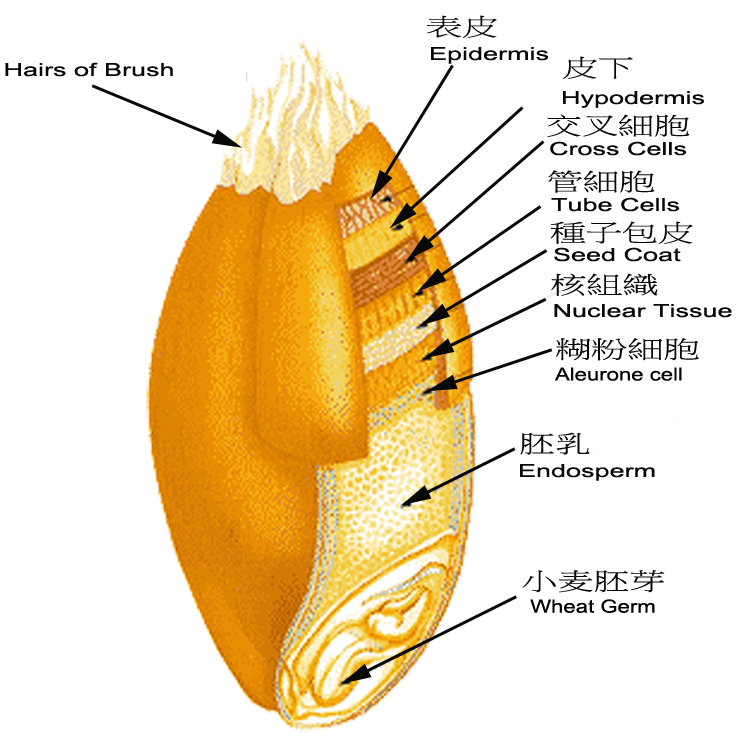
Firstly we clean the wheat, taking out the straw, small seeds like cockle and vetch as well as oats and barley.
Then we add water to soften the bran skins. This stops the bran from going to powder when we grind giving better bran flakes.
Wheat has an odd shape, it has a crease down the side of it. This means that we can not just polish off the bran, as we would be left with bran in the crease.
Rollers

We split the wheat open using steel rollers that have small teeth in them. You can see the teeth at the top of the picture. This roll is going away to be re-cut. The stamp on the side says it was made on the 24/10/1939.
Grinding

The top roll goes faster than the bottom. The wheat sticks to the bottom roll so that the faster top roll splits it open.
1st Break (grind)

After the first grind we have a mixture of bran, semolina and flour. It is then sieved. The bran goes off to be cut again as not all the endosperm has been released.
Semolina (term of granularity, when it is small enough we call it flour)

At every grind we create semolina. It is sieved on a machine that has air flowing through it. The small particles of bran float off and the heavy semolina falls through the sieve. You can see the wheat germ in the picture. This gets flattened by the rolls and can be sieved out at this stage. The semolina then goes to smooth rolls to grind it into flour. Semolina is very hard so we gradually reduce the semolina into flour by grinding and sieving several times.
Every time we grind we produce flour. So at any one time we are producing more than 15 streams of flour. They are all mixed in together to make one flour. If we want wholemeal then all the bran and wheatgerm are added back as well.
The end result is a consistent quality flour. It can absorb water (slows down the staling of bread) and feed the yeast (to give more lift).
Water Power
Turbine House

Out with the old and in with the new. My brother has been working on a project to redevelop our old mill site on the Thames. It has been derelict since it burnt down in 1945.
Part of the project is to introduce some greener ways of generating heat and power. The old mill turbine (right) is to become the new switch control house.
The Screw

To replace the old horizontal turbine, we have bought a hydro screw capable of generating 30 kw of electricity an hour.
The screw will use 3 cubic meters of water per second and will bring automatic level control to the river in Oxford.
My father (leaning against the new screw) can remember the noise of the old turbine when he was a little boy. If it stopped he used to wake up and wonder what was wrong. In those days it used to run 24/7 because of the war.
Please click Here to see how much energy we have generated this week.
Being lowered in place

The mill race floor before the river is let in

添加了隔音功能並開始運行
Sound proofing added and running

About Us
We are a small family flour mill based in Wantage, Oxfordshire. The Munsey family have been milling Oxfordshire for over a 100 years. The mill is currently run by fourth generation flour miller Paul, with his daughter Emily studying to become a miller as well.
Our flour is milled using local wheat that we collect ourselves from farms surrounding the mill. We ensure we only select the best wheat with high quality gluten by testing samples before we bring any into the mill. Being a small mill means we can store the wheats from each farm separately without batching. This allows us to carefully select the wheats that we mix together for the grist to produce quality consistent flour.
Wessex Mill is a traditional roller milling process, as opposed to the modern energy intensive method of debranning the wheat before grinding it into flour. We mill our flour slowly; this means the flour doesn't heat up as much as other flour mills, preventing the protein from damage.
The consistency of our flour is down to buying good wheat. The area around the mill produces some of the best wheats in the UK. We buy from local farms and pick the wheat up with our own lorries
You can find the names of the farms that we use on the packet.
We always welcome enquries.
Paul Munsey
Flour Miller
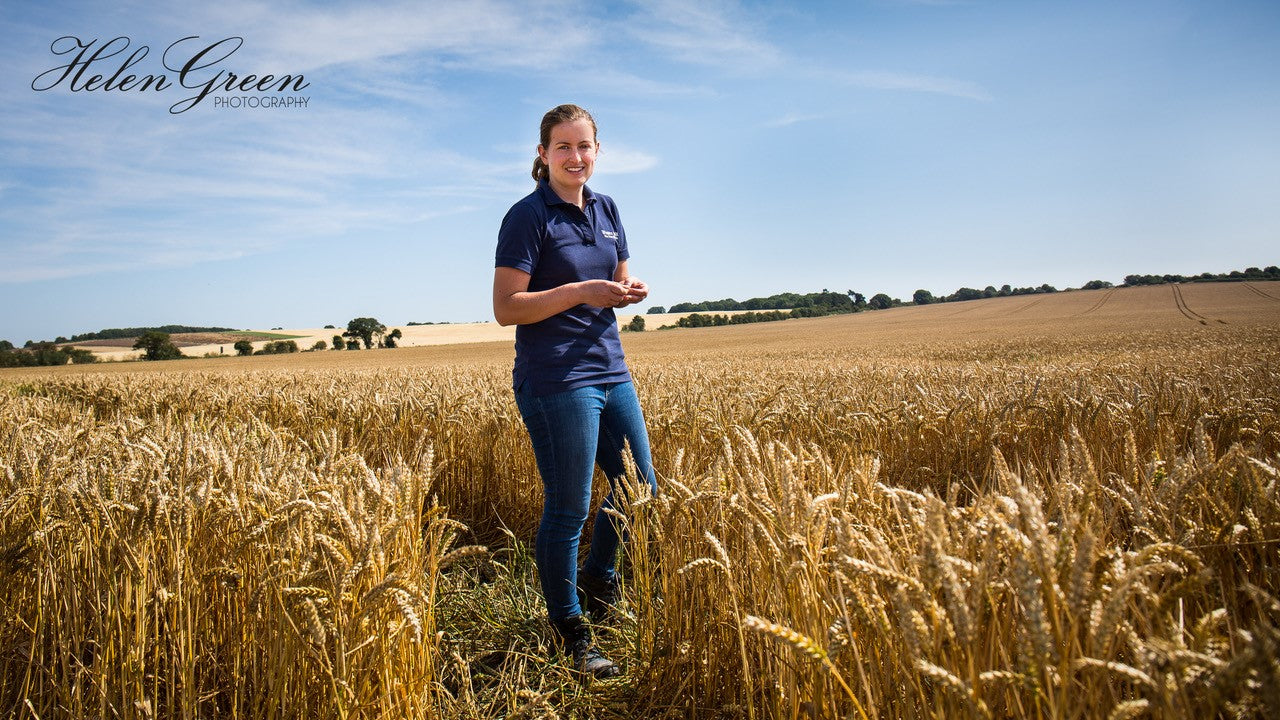
Wessex mill are proud to announce that a new generation of the family has decided to become a miller! Emily is going to be learning every aspect of milling and the business.
History
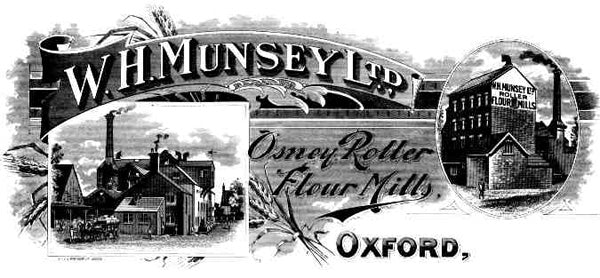
Tucked away in the small Oxfordshire town of Wantage sits Wessex Mill, run by father and daughter team, Paul and Emily Munsey. Tiny in comparison to many of the UK's flour mills, the award-winning establishment holds a strong milling history, with Emily joining in 2017 to continue a heritage that spans five generations.
The story begins in 1895 with Emily's great great-grandfather William Henry who was forced to relocate from Cambridge to Oxford following a devastating outbreak of foot and mouth, consequently moving from farming into flour milling. Originally starting as a partnership with Archer Cowley, the mill situated in Osney in Oxford became W.H. Munsey Ltd with William Henry taking complete ownership of the business in 1911. The family venture continued as sons Ellis and Keith joined the workforce but with the outbreak of World War I and milling not being essential work, Henry's sons both left Oxford to fight in The Great War.
Surviving the war, the brothers returned and settled back into milling, but in 1927 with the country in post-war depression, land owners Christ Church issued an ultimatum meaning the Munseys must purchase the land or vacate the mill. They managed to borrow the money and shortly after buying the mill, William Henry died.
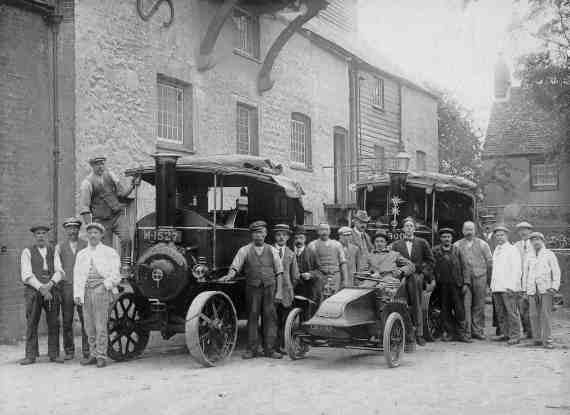
This picture was taken in 1911 at Osney Mill. In the car is Bill Muffin (Flour Salesman), behind his left shoulder is WH Munsey to his left his son Ellis.
Ellis and Keith continued to run the mill through the 1930s and, now too old, avoided having to fight in World War II. The war ended and the business continued, but in 1946 disaster struck with a fire that burned the Osney mill to the ground. With the country short of building supplies after the war, permission to rebuild the mill in Oxford was denied, so the brothers purchased Mr Clark's biscuit flour mill in Wantage to continue milling.
The mill carried on into its third generation with cousins Dick and Bill (sons of Ellis and Keith, respectively), and with a more stable global economic and political landscape for the remainder of the 20th century, Bill's son Paul joined the business in 1982. Today Tony, Bill's younger son runs the old mill site in Osney which in 2010 was converted into housing and includes a marina and hydroelectric screw.
With Emily and Paul at the helm, Wessex Mill has continued to succeed and grow as the quality producer of artisan flour it is today, shipping throughout the UK, and beyond.